Table of Contents
- Best Chef Knife for Home Cooking: A Practical Buying Guide
- What to Look for in the Best Chef Knife for Home Cooking
- Can One Chef Knife Handle Most Everyday Kitchen Tasks?
- A Practical 8-Inch Option from GLOBEHOME
- Chef Knife vs. Santoku Knife
- What Is a Chef Knife Used For?
- How to Use a Chef Knife Safely
- How to Clean and Maintain a Chef Knife
- Frequently Asked Questions
- Which Chef Knife Is Right for Home Cooking?
Best Chef Knife for Home Cooking: A Practical Buying Guide
Choosing the best chef knife for home cooking does not require buying a large knife set or choosing the most expensive blade available.
For most home cooks, one comfortable and versatile chef knife can handle the majority of everyday preparation tasks.
The right knife should feel secure in your hand, provide enough blade length for common ingredients, retain a practical working edge, and be straightforward to maintain.
This guide explains the key features to compare and why a well-designed 8-inch chef knife can offer a practical balance of control, cutting length, and versatility for everyday home cooking.
What to Look for in the Best Chef Knife for Home Cooking
There is no single chef knife that is best for everyone.
The right knife depends on your cooking habits, hand size, cutting style, and maintenance preferences.
Before choosing a knife, consider:
- Blade material
- Blade construction
- Blade length
- Weight
- Handle comfort
- Balance
- Edge performance
- Maintenance requirements
- Intended use
Blade Material and Construction
Blade material affects sharpness, durability, corrosion resistance, maintenance, and how the knife feels during use.
High-carbon stainless steel is a popular choice for everyday kitchen knives because it can provide a useful balance of hardness, edge retention, and stain resistance.
A harder blade can generally maintain a useful cutting edge well, although every kitchen knife still requires appropriate use and periodic sharpening.
Damascus usually describes a layered blade construction and the visible pattern created by those layers.
However, the word "Damascus"alone should not be treated as an automatic guarantee of overall knife quality.
Other important factors include:
- Core steel
- Heat treatment
- Blade geometry
- Edge angle
- Handle construction
- Balance
- Manufacturing consistency
- Quality control
Terms such as German-style and Japanese-style also describe general design traditions rather than universal quality standards.
German-style chef knives are often associated with a more curved blade profile and a more substantial feel, while Japanese-style knives are often lighter and thinner.
Individual knives can differ considerably, so the actual specifications and design matter more than the label alone.
Blade Length and Weight
Chef knives commonly range from approximately 6 to 10 inches.
A shorter knife may feel easier to control, but it provides less cutting length for larger vegetables or portions of meat.
A longer knife covers more food with each stroke but may feel less manageable in a small kitchen or on a compact cutting board.
For many home cooks, an 8-inch chef knife offers a practical middle ground.
It provides enough blade length for ingredients such as:
- Onions
- Cabbage
- Squash
- Root vegetables
- Fruit
- Boneless meat
- Other everyday ingredients
while remaining manageable on a standard home cutting board.
Weight is also a personal preference.
A lighter knife may feel more agile, while a slightly heavier knife can feel steady during chopping.
The goal is not to choose the lightest or heaviest knife. The goal is comfortable, controlled handling during everyday preparation.
Handle Design, Balance, and Comfort
A chef knife should feel secure without requiring excessive grip pressure.
Look for:
- A handle shape that fits your hand
- Minimal uncomfortable pressure points
- A stable transition between the blade and handle
- Natural balance
- Easy directional control
Balance can affect how easily the knife changes direction and how tiring it feels during longer preparation sessions.
Because comfort is personal, hold the knife safely when possible and consider how controlled it feels in your usual cutting position.
Edge Performance and Maintenance
A useful kitchen edge should cut food cleanly without requiring unnecessary force.
It should also be durable enough for normal preparation when used on an appropriate cutting board.
No chef knife stays sharp indefinitely.
Honing may help maintain alignment on some edges, while sharpening removes a small amount of metal to restore the cutting edge.
The appropriate method depends on the knife and the sharpening equipment being used.
Avoid judging a knife only by marketing claims such as "razor sharp".
Long-term performance also depends on:
- Steel
- Heat treatment
- Edge geometry
- Cutting surface
- Storage
- Usage habits
- Maintenance
Price and Everyday Value
Price alone does not determine whether a chef knife is suitable for your kitchen.
A practical value assessment should consider:
- Blade material and construction
- Comfort and balance
- Tasks the knife can safely perform
- Maintenance requirements
- Packaging and included accessories
- Return and warranty terms
- How frequently the knife will be used
A knife used every day may offer more practical value than several specialized knives that remain in a drawer.
Can One Chef Knife Handle Most Everyday Kitchen Tasks?
For many home kitchens, a single versatile chef knife can serve as the main preparation tool.
Using one primary knife consistently can also help you become familiar with the same:
- Blade shape
- Weight
- Balance
- Grip
- Cutting motion
A versatile chef knife can handle common tasks such as:
- Slicing vegetables and fruit
- Dicing onions and root vegetables
- Chopping herbs
- Mincing garlic
- Portioning boneless meat
- Slicing cooked meat
- General daily meal preparation
However, a chef knife is not designed for every kitchen task.
A serrated knife is usually more suitable for crusty bread, while a small paring knife provides greater control for delicate peeling and trimming.
Bones, frozen food, and extremely hard ingredients require an appropriate specialized tool.
Do not force a chef knife through materials it was not designed to cut.
A Practical 8-Inch Option from GLOBEHOME
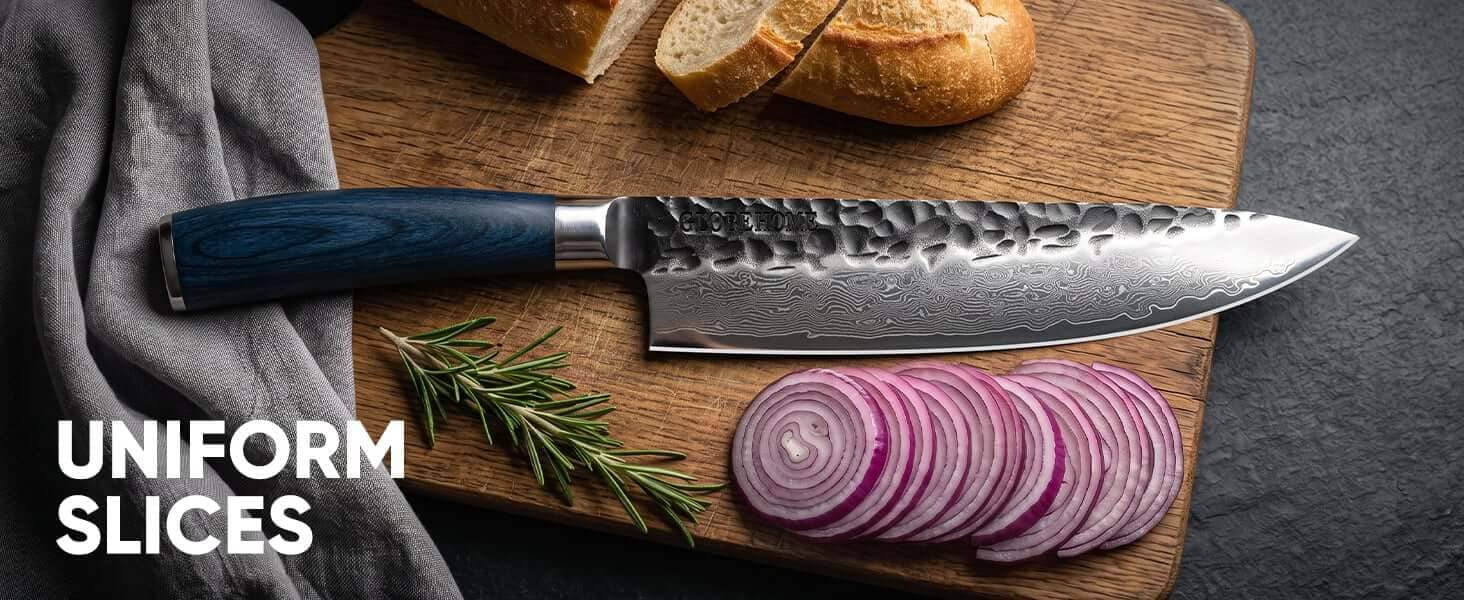
The GLOBEHOME 8-Inch Damascus Chef Knife is designed as a general-purpose knife for everyday home preparation.
Its purpose is not to add unnecessary complexity to the kitchen, but to handle frequent slicing, dicing, chopping, mincing, and meal-prep tasks with a versatile blade format.
Product Specifications
| Feature | Specification |
|---|---|
| Product type | Chef knife |
| Blade length | 200 mm / approximately 8 inches |
| Overall length | 330 mm / approximately 13 inches |
| Steel core | 10Cr15MoV high-carbon stainless steel |
| Hardness | 60±1 HRC |
| Damascus construction | 67 layers: 66 outer layers + 10Cr15MoV steel core |
| Blade manufacturing | Stamped |
| Edge angle | 20–24° |
| Knife weight | Approximately 210 g |
| Handle material | Pakkawood |
| Packaging | Gift box included |
The 200 mm blade provides enough length for common slicing, chopping, and dicing tasks.
At approximately 210 grams, the knife is designed to provide a steady feel while remaining manageable for everyday preparation.
The knife uses a 10Cr15MoV high-carbon stainless steel core hardened to 60±1 HRC.
Its 67-layer Damascus construction combines 66 outer layers with the 10Cr15MoV steel core, creating the blade’s distinctive layered appearance.
The blade is produced using a stamped construction process.
The Pakkawood handle provides a warm wood appearance and a shaped surface for everyday handling.
Comfort can still vary depending on hand size and grip style, so personal preference remains important when evaluating any kitchen knife.
The knife is intended for:
- Vegetables
- Fruit
- Herbs
- Fish
- Boneless meat
- General everyday meal preparation
It should not be used to cut:
- Bones
- Frozen food
- Extremely hard ingredients
The knife is also available through the GLOBEHOME Amazon listing.
Chef Knife vs. Santoku Knife
Chef knives and santoku knives can perform many of the same kitchen tasks, but their blade shapes and common cutting styles differ.
| Feature | Chef Knife | Santoku Knife |
|---|---|---|
| Typical blade profile | More curved cutting edge | Generally flatter cutting edge |
| Common motion | Rocking, slicing, and chopping | Forward cutting and up-and-down chopping |
| Typical length | Often 8–10 inches | Often 5–7 inches |
| Often chosen for | Broad everyday preparation | Controlled vegetable, fish, and boneless-meat preparation |
| General feel | More blade length and rocking space | Shorter and often lighter |
A chef knife may feel more natural to cooks who use a rocking motion or regularly prepare larger ingredients.
A santoku may appeal to people who prefer a shorter blade and a more vertical chopping motion.
Neither design is automatically better.
The right choice depends on:
- Cutting technique
- Hand size
- Cutting-board space
- Typical ingredients
- Preferred blade length and weight
What Is a Chef Knife Used For?
A chef knife is designed to perform several core preparation tasks.
Slicing
The blade length allows controlled slicing through:
- Vegetables
- Fruit
- Fish
- Boneless meat
- Cooked foods
Use a smooth, controlled motion and keep the food stable on the cutting board.
Dicing
A chef knife can dice:
- Onions
- Carrots
- Potatoes
- Peppers
- Other everyday vegetables
Consistent cuts can also help ingredients cook more evenly.
Chopping
The broad blade and curved edge support chopping:
- Herbs
- Vegetables
- Everyday preparation ingredients
Keep the tip and edge controlled rather than striking the cutting board with excessive force.
Mincing
Garlic, herbs, and similar ingredients can be minced using a controlled rocking or chopping motion.
Keep the guiding hand safely away from the cutting path.
Portioning Boneless Meat
A chef knife can portion:
- Boneless poultry
- Fish
- Other boneless meat
A chef knife is not a cleaver and should not be forced through:
- Bones
- Joints
- Frozen food
How to Use a Chef Knife Safely
A sharp kitchen knife should always be used with deliberate, controlled movements.
Place the cutting board on a stable surface.
If it moves, place a damp kitchen towel or an appropriate nonslip mat underneath it.
Hold the ingredient with your fingertips curled away from the blade.
Keep the knife under control throughout the cut.
If the knife falls, do not attempt to catch it.
Use:
- Wood
- Rubber
- Other suitable food-safe cutting surfaces
Avoid cutting directly on:
- Glass
- Stone
- Ceramic
- Metal
These hard surfaces can damage or prematurely dull the cutting edge.
After use, do not leave the knife hidden in a sink or mixed underneath other utensils.
Clean, dry, and store it promptly.
How to Clean and Maintain a Chef Knife
Good maintenance helps protect the blade, handle, cutting edge, and overall appearance.
- Wash the knife by hand with mild dish soap and a soft sponge.
- Keep your fingers away from the cutting edge while cleaning.
- Rinse the knife without leaving it submerged in water.
- Dry the blade and handle immediately with a clean towel.
- Store it in a knife block, fitted sheath, in-drawer tray, or appropriate magnetic holder.
- Use an appropriate sharpening method when the knife begins to crush or slip on food instead of cutting cleanly.
For the best long-term care, hand washing and immediate drying are recommended rather than routine dishwasher cleaning.
Dishwasher heat, moisture, strong detergent, and contact with other utensils may affect the cutting edge, handle finish, and overall appearance over time.
For more detailed care guidance, read:
How to Care for a Damascus Knife
Frequently Asked Questions
Is an 8-inch chef knife suitable for beginners?
An 8-inch chef knife is a practical starting size for many home cooks because it provides useful cutting length without requiring as much working space as a 10-inch knife.
Comfort still depends on:
- Hand size
- Cutting technique
- Knife weight
- Balance
- Personal preference
Can one chef knife handle most kitchen tasks?
One chef knife can handle most everyday:
- Slicing
- Chopping
- Dicing
- Mincing
- Boneless-meat preparation
A serrated bread knife and a small paring knife may still be useful for tasks that require a different blade shape.
Is a Damascus chef knife better than ordinary stainless steel?
Not necessarily.
Damascus construction can provide a distinctive layered appearance, but the word “Damascus” alone does not determine overall knife quality.
Other important factors include:
- Core steel
- Heat treatment
- Blade geometry
- Construction
- Comfort
- Balance
- Maintenance
Can the GLOBEHOME chef knife cut bones or frozen food?
No.
The knife is intended for ordinary kitchen preparation, including:
- Vegetables
- Fruit
- Herbs
- Fish
- Boneless meat
Bones, frozen food, and extremely hard ingredients can damage the cutting edge.
Can this chef knife go in the dishwasher?
For the best long-term care, hand washing and immediate drying are recommended instead of routine dishwasher cleaning.
This helps protect the:
- Blade
- Cutting edge
- Handle finish
- Overall appearance
How often should a chef knife be sharpened?
There is no universal sharpening schedule.
Sharpen the knife when it no longer cuts cleanly with normal, controlled pressure.
Frequency depends on:
- How often the knife is used
- Cutting surface
- Storage method
- Maintenance habits
- Types of food being prepared
Which Chef Knife Is Right for Home Cooking?
The best chef knife for home cooking should match your:
- Hand size
- Cutting technique
- Kitchen space
- Typical ingredients
- Everyday preparation habits
For many households, one comfortable 8-inch chef knife can perform the majority of routine preparation tasks without requiring a large knife set.
The GLOBEHOME 8-Inch Damascus Chef Knife combines:
- A 200 mm / approximately 8-inch blade
- 10Cr15MoV high-carbon stainless steel core
- 60±1 HRC hardness
- 67-layer Damascus construction
- 66 outer layers + 10Cr15MoV steel core
- Stamped blade construction
- 20–24° edge angle
- Approximately 210-gram weight
- Pakkawood handle
It is designed for everyday slicing, chopping, dicing, mincing, and general meal preparation.
Use it with an appropriate cutting board, avoid bones and frozen food, and clean, dry, and store it promptly after use to help maintain its performance over time.